


Understanding Tastes and Flavors
Understanding Tastes and Flavors is one of the most excellent entry level one day sensory classes for people completely new to coffee or people who have yet to work in the sensory analysis or quality evaluation realm of coffee.
Understanding Tastes and Flavors is one of the most excellent entry level one day sensory classes for people completely new to coffee or people who have yet to work in the sensory analysis or quality evaluation realm of coffee.
People currently employed in coffee like Roasters, Machine Operators, Salespeople, Baristas, and Entrepreneurs looking to start their own coffee business all find benefit in this class.
Many individuals we’ve worked with over the years tell me they don’t understand how to describe coffee, they say they are bad at it, or that their weakest area is sensory. What we find is, those people aren’t bad at analyzing the tastes and flavors in the coffee, they just aren't comfortable or used to it.
Our culture doesn’t spend much time thinking about or describing the things we consume. If we discuss something food or beverage related, it’s usually in terms of good or bad – "I like it, I don’t like it”. Or, we might say a dish is too much or too little of something. It’s too salty, it’s not seasoned enough, it’s too spicy.
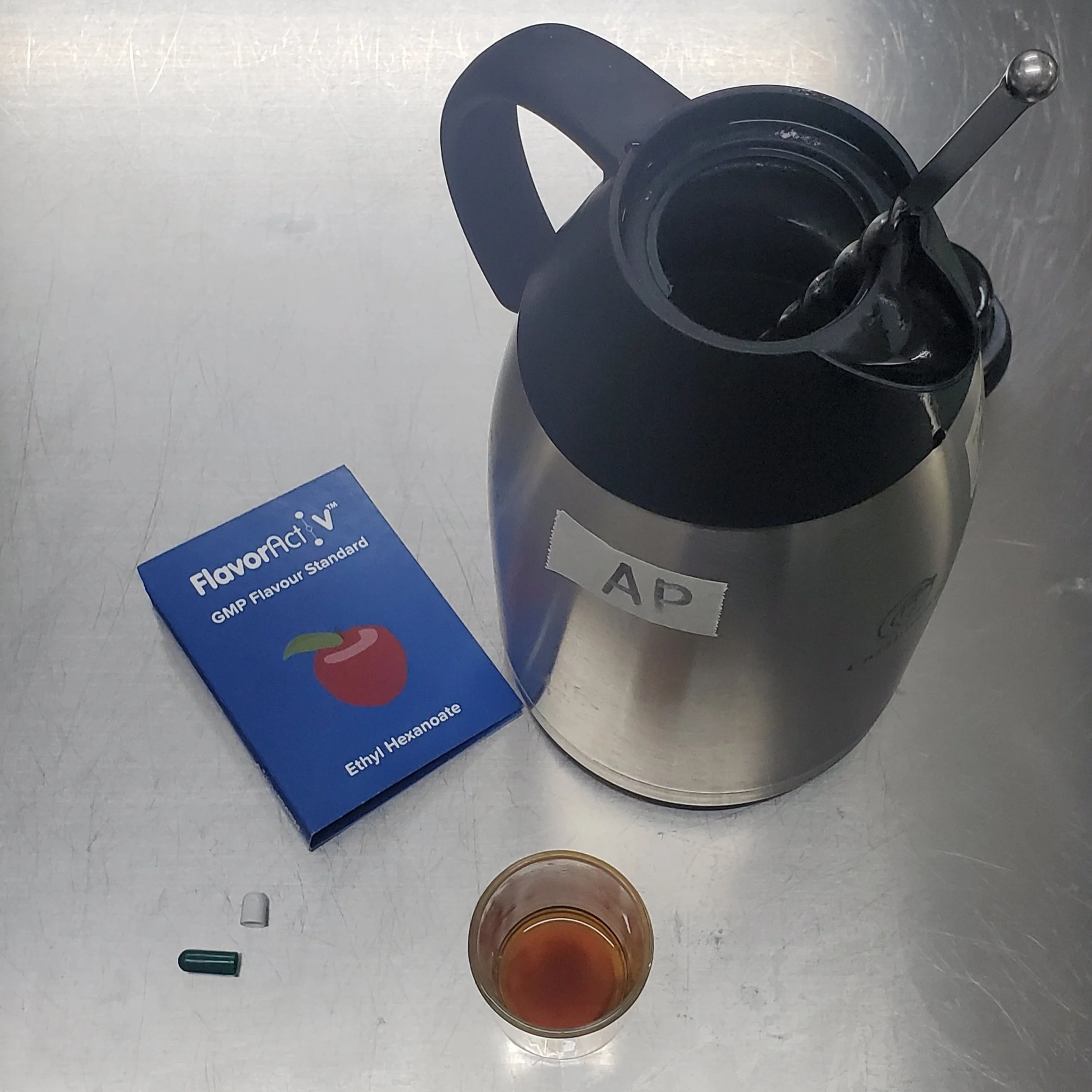
flavoractiv is used to spike a plain cold brew coffee with single flavors to aid in identification and recall.
When asked what additional classes individuals are interested in, Sensory is the number one answer. Another request we get all the time is for Q PREP class. Those of you who’ve asked will be happy to know that THIS IS A Q PREP CLASS! After completing this class, a person will have an increased understanding in completing the cupping form, specifically Flavor, Aftertaste, and Body
This class also isolates and explores our sense of taste – using solutions with individual tastes- sweet, sour, salty, and bitter with no associated smell, we can better understand these components of coffee. Usually when we eat or drink something sweet, it’s associated with the basic taste of sweet but also contains multiple aromatics and texture. For example, shortbread is sweet, but it is also buttery, caramelly, and crunchy. Or grapefruit has grapefruit and floral aromatics, but it also has sharp acidity and bitterness which can cause confusion between the two tastes. Taking the time to experience each taste on its own helps to clarify the tastes for the individual.
In addition to clarifying tastes, this class also gives individuals a chance to analyze the same coffee multiple times but each time with one flavor difference, for example an added strawberry flavor or a medicinal note. Doing this allows a person to focus on a single flavor and describe it rather than having to view the entire coffee in all its complexity and pick out all the flavor notes.
And finally, this class offers a chance to isolate some specific body terms like thick, syrupy, astringent, and spicy.
The first time we taught this course was during an ACDI/VOCA PhilCAFE project in the Philippines. We were chosen by the Coffee Quality Institute to deliver the course with Cherry Cruz and her excellent team at The Barista and Coffee Academy of Asia. This was a relatively new course offering by CQI during this time. We were excited to deliver this course and happy to see how clearly and simply the concepts of taste and flavor were broken down and received by the attendees.

The crew from this round of PhilCAFE training after tasting defects.
This is a great opportunity for coffee professionals who are interested in improving their palate with goals like increased confidence when describing coffee and improving cupping skills. We are looking forward to adding this to the offerings from CoLabOps at the Lab at Royal NY starting in May!

Flavor Wheel and the Sensory Lexicon
Besides being a go-to guide for what you are likely to find when you are sipping and slurping, the Flavor Wheel is also categorized in a way that novice tasters can use to explore from broad flavors in the middle to gradually more specific as you work your way out. Does the coffee taste fruity? What kind of fruit? A Berry? What kind of berry? Blueberry! The same can be done with any of nine broad categories working your way to more and more specific flavors as you develop your sensory skills.
Here at CoLabOps we teach Barista, we teach Roasting, we teach Brewing, but the one thing that we teach that runs through all of these is: We Teach Sensory!
Sensory is the common thread with all the coffee skills that we teach because if we haven’t honed our palate, if we don’t know how to taste critically, honestly, and in an organized manner then it’s almost impossible to find the flavors and executions we are looking for in our coffees.
Fortunately for us, many intelligent & organized people have done a lot of work ahead of us to make our lives easier. One of the most powerful tools these palate pioneers have bequeathed is the SCA Coffee Taster’s Flavor Wheel.

The Specialty Coffee Association’s Coffee Taster’s Flavor Wheel.
Initially launched in 1995 and evolved to its current state in 2016, the Flavor Wheel is your one-stop shop for commonly agreed upon attributes that can be found in specialty coffee, observed in the U.S.
Besides being a go-to guide for what you are likely to find when you are sipping and slurping, the Flavor Wheel is also categorized in a way that novice tasters can use to explore from broad flavors in the middle to gradually more specific as you work your way out. Does the coffee taste fruity? What kind of fruit? A Berry? What kind of berry? Blueberry! The same can be done with any of nine broad categories working your way to more and more specific flavors as you develop your sensory skills.

From the WCR Sensory Lexicon - The Blueberry reference is the slightly dark, fruity, sweet, slightly sour, musty, dusty, floral aromatic associated with blueberry. These definitions are one of the great advantages of using this tool. Check out this Instagram page for a nice reference.
But how do we define these flavors?
The World Coffee Research organization had the same question and worked with The Sensory Analysis Center at Kansas State University and thus was born the Sensory Lexicon. The Lexicon is a comprehensive list of 110 flavors, textures, and aromas present in coffee with specific and easily obtainable references (in the US, anyway).
The flavor wheel as a tool, however efficient and organized it is, can be daunting, and this is why we love to take the time to acquire as many of these references as possible and create a tasting experience along with a cross section of coffees with similar attributes.
Our Exploring the flavor class will offer a chance to do just that, in a laid back and conversational environment with our skilled. team as well as a group of peers looking to dive into the world of sensory without needing to be a sommelier.

Workshop held at Bluekoff Thailand